Here we'll go over how to connect, configure and format a SATA I / II hard drive on Linux. The intent for this drive ultimately was to share the drive through SAMBA between our home PC's and to hold home movies from the Sony HDR-SR7 camcorder I have. Ultimately, I will be using this drive and ffmpeg to convert movies from M2TS format to AVI format using the x264 codec available on Linux. I'll need the space.
Here's how to go about doing just this:
Read the rest of this entry »
July 28th, 2009 | Posted in NIX Posts | 1 Comment
There are plenty of ways to share resources and files between two or more computers. You could do things like:
-
Email yourself an attachment.
-
Use FTP between the two PC's.
-
Use SSH between the two computers.
-
Use sneaker-net: copy the files to Flash Disk, DVD, CD, (gulp) floppy etc. and walk over to the other computer then load them up.
-
Copy the file by hand.
-
etc (It pretty much just goes downhill from here).
Or you could enable NFS or better yet, as we will discuss here, use SAMBA and share entire folders, allowing you to simply save to a shared folder making the file / folder visible from other PC's on your network.
We will therefore do two things over the network in this post using SAMBA:
-
Mount Windows shared folders on Linux.
-
Map Linux shared folders (Using Map Network Drive… option) on Windows.
This of course will be different then simply mounting partitions on the same machine as we have outlined in Windows / Linux: Mutually accessing various filesystems on the same PC. since will be doing this type of sharing over the network instead of just on the same PC. In this post we will share folders between Fedora Linux and Windows, though the general config of the applications can apply to other distributions. Overall, having said the above, here's how the setup can look like for you as well:
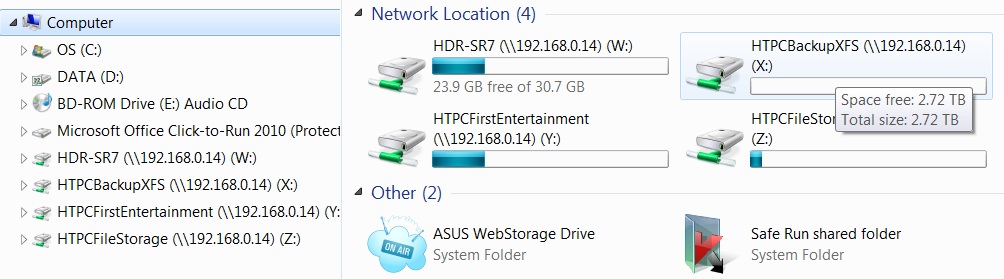
Here's how to get this done:
Read the rest of this entry »
July 27th, 2009 | Posted in NIX Posts, Windows | 11 Comments
Well, Fedora 11 has been out for some time now. And though I've been coping with the new KDE 4.0 deployment, my general experience has left me somewhat unsatisfied, though sure enough, there are good points about it. Somehow I don't feel alone but can't help stick with it. After all, KDE 4.0 is a COMPLETE rewrite of KDE in Qt4 and this sort of stuff is to be expected.
With new things comes new apps like KDE 4.3 which I've been itching to get my hands on. So with time permitting, I can get to do some updates in hope of getting lot's of the old functionality back in KDE or simply adapting to my new environment.
Without further delay it's time to do some updates:
Read the rest of this entry »
July 11th, 2009 | Posted in NIX Posts | 2 Comments
This is a fine one. Anyone who uses WordPress may need to deal with this. Unfortunately, despite using reCAPTCHA, Akismet still picks up tons of span on my blog. So why am I getting spam comments when I have reCAPTCHA? The answer could surprise you. Read the rest of this entry »
July 1st, 2009 | Posted in NIX Posts, Web | 6 Comments
PROBLEM
Another day brings another bug. This time it's with the Akonadi server failing or unable to start. This error followed a recent update I've done on my Fedora box. This is what greeted me each time I started up KDE:
The QtSQL driver 'QMYSQL' is required by your current Akonadi server configuration.
The following drivers are installed: QSQLITE, QMYSQL3, QMYSQL.
Make sure the required driver is installed.
Personally, I don't like uninvited guests, especially the ones that crash the party. So off I went to see what broke. The error gave some clues where I should look which included MySQL, akonadi and QtSQL. Here's how I went about resolving this one.
SOLUTION
Read the rest of this entry »
March 29th, 2009 | Posted in JADDB, NIX Posts | 5 Comments
PROBLEM
On Linux, you receive this error when trying to open up links from inside Thunderbird emails:
Error showing url: Failed to execute child process "/usr/lib/firefox-3.0.5/firefox" (No such file or directory)
SOLUTION
Read the rest of this entry »
March 17th, 2009 | Posted in NIX Posts | No Comments
PROBLEM
Just today an issue came up for me installing the google toolbar. (This Google toolbar has been in Beta for a while now, which caught my attention and may or should catch yours: Beta releases are buggy. That may be beside the point though since I don't care as long as it does it's job well since some company's betas are better then other companies official releases. 🙂 )
I got this cryptic error:
Firefox could not install the file at
http://dl.google.com/firefox/google-toolbar-beta-linux.xpi
because: Signing could not be verified
-260
Read the rest of this entry »
February 16th, 2009 | Posted in NIX Posts, Windows | 7 Comments
Hashes are a certainly very important part of any language. If you're not used to hashes, you may not see their potential at first. However, having used them in several languages now, hashes always ended up reducing my code significantly especially when only complex solutions would only do otherwise. However, bash or ksh for that matter, don't really come with such a construct. Reading up on how to do such a thing really didn't provide any elegant solutions that I wanted for most scenarios. What I really wanted is something that had these features: Read the rest of this entry »
February 6th, 2009 | Posted in NIX Posts | 4 Comments
INTRODUCTION
Most people today know or have some idea what a firewall is. For those not too familiar with it, it’s essentially a piece of software or hardware that sits between your computer and the internet (outside world) helping to prevent unauthorized access to your computer / workstation. The firewall does this by blocking certain ports on your workstation that applications normally use to communicate with over networks. It does this to hide vulnerable applications from being exposed to potentially malicious break in attempts. The firewall’s granularity typically reaches and is limited to filtering the type of protocols allowed on as little as a single IP, the direction (IN / OUT = TO / FROM your computer) of the traffic and as broad as blocking entire sets of IP’s (For example 50.N.N.N – 150.N.N.N). This is really the broad range of what a typical firewall can do. Read the rest of this entry »
January 14th, 2009 | Posted in NIX Posts | 1 Comment
Apache HTTPD is the most popular web server to date. It's extensible and configurable to meet various needs both small and big. Here we'll focus on extending it's reporting functionality by enabling full status capability to see more granularity in status reports. As you probably know, the service on Red Hat Linux systems can be controlled with the service command like this: Read the rest of this entry »
January 14th, 2009 | Posted in NIX Posts | 8 Comments


